Outsourcing private security response has a reputation problem, and for facilities managers and security companies the concern is understandable. Handing work to a subcontractor can mean giving up direct control over who attends a site, whether they arrive when expected, what they do once they get there and how quickly you find out when something goes wrong.
Much of that concern comes from what happens when responsibility is outsourced along with the work. Poor visibility, inconsistent service delivery and weak communication have all contributed to scepticism around subcontracted security in the UK. When a responder fails to arrive, a task is completed incorrectly or a customer has to chase for an update, the model starts to feel risky very quickly.
Outsourced private security response doesn't have to work that way. With clear standards, the right technology and active oversight of each callout, it is possible to extend physical security response across a much wider area while still knowing what is happening on site and who is accountable for it.
Private security response can be outsourced without losing control when it combines vetted response companies, clear site instructions, live tracking of each callout, a control room that manages the job through to completion and a structured report at the end. The customer keeps oversight of the service, and accountability stays intact.
Why traditional security subcontracting creates concern
At its simplest, subcontracting introduces another layer between the security company or facilities management provider and the person delivering the service on site. That distance can become a problem when there is no reliable way to see what is happening.
Has the responder been dispatched? Are they on their way? Have they arrived at the right location? Did they complete the required checks? Was the site secured? If something changed during the callout, who communicated it?
Without clear answers, the customer is dependent on updates being passed manually through the supply chain, which becomes particularly difficult when something goes wrong.
Most customers understand that security services involve people, vehicles and unpredictable conditions on the ground, and that delays and setbacks can happen. Confidence suffers when nobody can explain what is happening, what is being done about it or when it will be resolved.
Good outsourcing therefore has to solve two problems at once: the work needs to be done properly, and the customer needs to be able to see that it is.
Accreditation matters, but it is only the starting point
The UK security industry already has important safeguards in place. Individual security personnel are licensed by the Security Industry Authority (SIA), while security companies can participate in the SIA's Approved Contractor Scheme (ACS), which assesses businesses against standards covering areas including operations, management, recruitment and service delivery.
AURA's UK responders are vetted SIA officers, and the response companies in its UK response network must meet the relevant standards, including ACS accreditation. That matters, but accreditation alone cannot guarantee a consistent experience every time a security service is delivered. Standards provide the foundation, and the next question is how the work itself is managed.
Visibility changes how private security response is outsourced
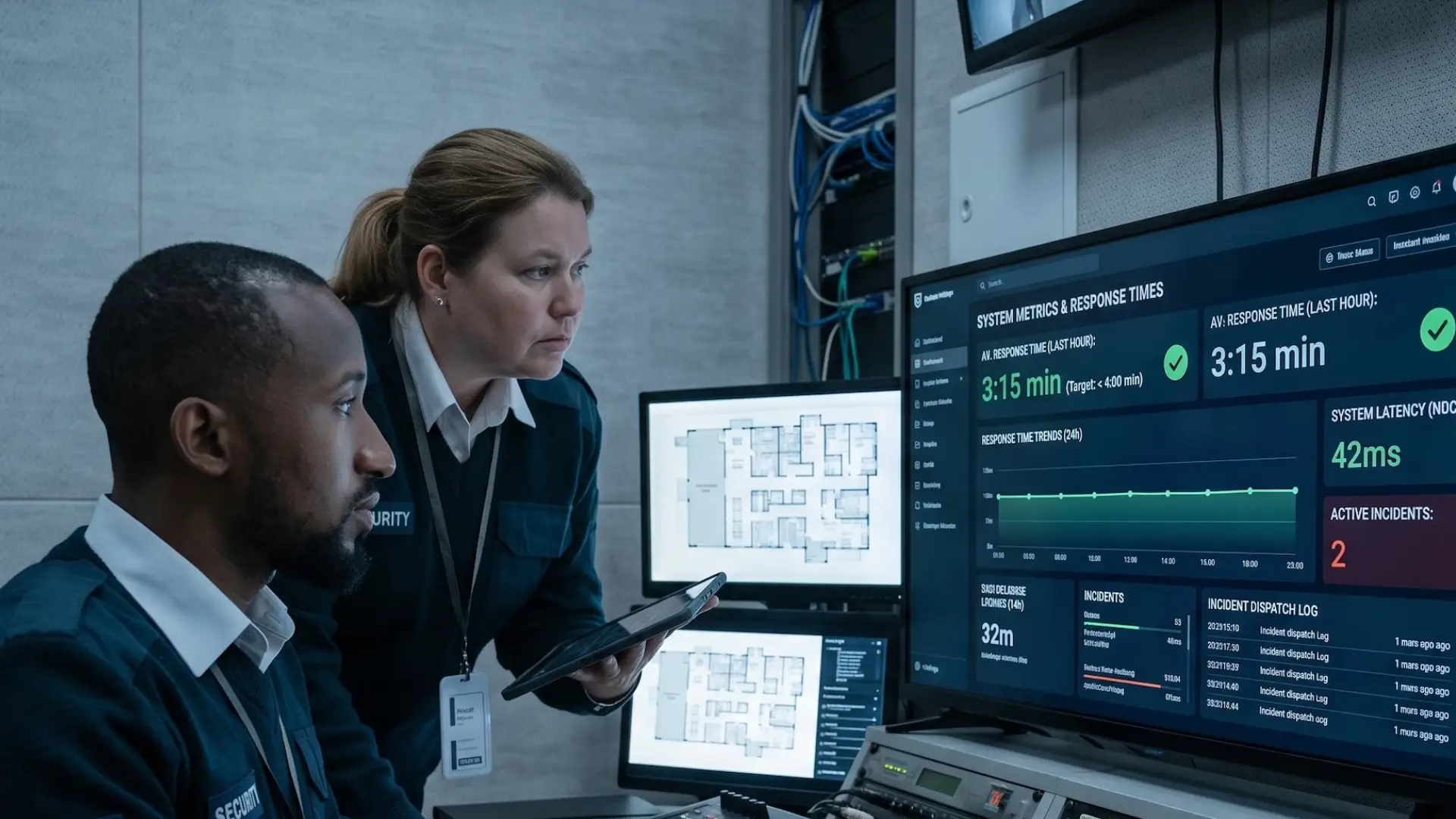
A modern security response platform can let customers follow a callout while it is happening, rather than reading a report after the fact.
Through the AURA platform, customers can track the progress of a response in real time and see where the responder is within the callout lifecycle, from dispatch through to completion.
Site-specific requirements can also be built into the process. A responder may need to check a car park, inspect a loading bay, complete an external perimeter check or follow another set of instructions relevant to that property. Those requirements can be defined in advance through task lists, standard operating procedures and emergency operating procedures.
Geofencing can support time and attendance records, while structured reporting creates an audit trail once the job is complete.
Instead of sending a job into a supply chain and hoping it is completed correctly, the customer can see the response progressing and receives proof of what happened. That gives them something traditional outsourcing has often struggled to provide: control over the work without having to employ and manage every responder themselves.
Technology does not replace operational oversight
There is an easy comparison to make between an on-demand response platform and other technology-enabled marketplaces. A job is created, an available provider accepts it and technology connects demand with supply.
But private security response cannot be reduced to an algorithm and an app. Every site carries different risks, instructions change and responders run into situations nobody planned for. Some callouts are straightforward and others are not.
For that reason, AURA combines its technology with its own in-region control room team to each response.
The control room does not replace an Alarm Receiving Centre (ARC), monitor alarms or decide whether an alarm should trigger a response. Once a response has been initiated, the team helps manage that callout through to completion. They have the relevant site instructions to hand and can help with communication when something changes or needs intervention.
Having people manage the callout matters because accountability cannot disappear once the job has been dispatched.
From callout reporting to better security decisions
There is another advantage to managing private security response through a technology platform: every callout generates useful data, and over time individual incidents start to reveal patterns.
A property may see repeated incidents in one particular area, or some sites may need significantly more response than others. Incidents may cluster at specific times. An organisation may also discover that it is spending heavily on one type of security service while the risk is showing up somewhere else entirely.
AURA's analytics let customers bring callout information together and look at trends for individual sites or across a wider portfolio.
Instead of simply asking, "Did the responder arrive?", facilities management and security teams can start asking better questions.
Where are our most vulnerable locations? Are the security measures currently in place addressing the risks we are actually experiencing? Are there gaps between scheduled patrols? Would some locations benefit from static guarding while others could be protected more efficiently through on-demand response?
Those answers can shape decisions about risk and about where the security budget goes. The incidents a response provider handles today can then help customers decide how to protect their properties in future.
Outsourcing should extend capability, not dilute accountability
Facilities management and security companies have good reasons to question subcontracted private security response models. If outsourcing means less visibility, inconsistent standards and limited control over the outcome, scepticism is justified.
Those weaknesses are not inevitable, though. A strong outsourced response model combines vetted response companies with clear site instructions, live tracking of each callout, a control room that manages the job through to completion and a structured report at the end. The customer gets oversight of the service without having to build and manage an entire response fleet, and accountability stays intact.
When an alarm rings or a security incident occurs, someone still needs to respond, follow the correct procedures and see the situation through to completion. Outsourcing the response should never mean outsourcing responsibility for the outcome.