Alarm installer programme: how UK installers add on-demand response to grow recurring revenue
An alarm installer programme lets an independent installer company resell a capability it doesn't build itself. AURA's alarm installer programme adds on-demand physical response as a flat-rate, hardware-agnostic monthly subscription on top of whatever you already fit. You buy wholesale, set your own retail price, and keep the recurring margin; no vehicles, no guards, no change to your monitoring centre.
Most UK security installers earn from two things: fitting hardware and charging a monthly monitoring fee. Both are under increasing margin pressure.
Neither answers the question clients now ask first. What actually happens when the alarm goes off?
An alarm installer programme is how a growing number of independent UK companies answer it, adding physical response as a a third recurring revenue stream.
What is an alarm installer programme?
An alarm installer programme, also called a security reseller, dealer, or channel partner arrangement, is a wholesale agreement that lets you offer a capability you don't need to build yourself.
You resell the service at a retail price you control, and the provider delivers it behind the scenes, under your client relationship.
The distinction that matters is what you're reselling. Most programmes recruit you into a single brand's hardware and monitoring ecosystem.
AURA's alarm installer programme is hardware-agnostic: it sits on top of whatever you already fit, under your own brand and your own client relationships. You aren't switching product lines or becoming a badged branch of a national provider.
What to look for in an alarm installer programme
Not every programme gives installers the same level of control. Five questions help separate a genuine capability from a simple reseller arrangement:
Does it tie you to one manufacturer? Hardware-agnostic programmes layer onto your existing product mix; closed ones replace it.
Who owns the client relationship? The contract, billing, and customer communication should remain with you.
Do you set the retail price? If the provider fixes it, your margin is fixed too.
How does it work with your ARC? Physical response should integrate with your alarm receiving centre, not compete with it.
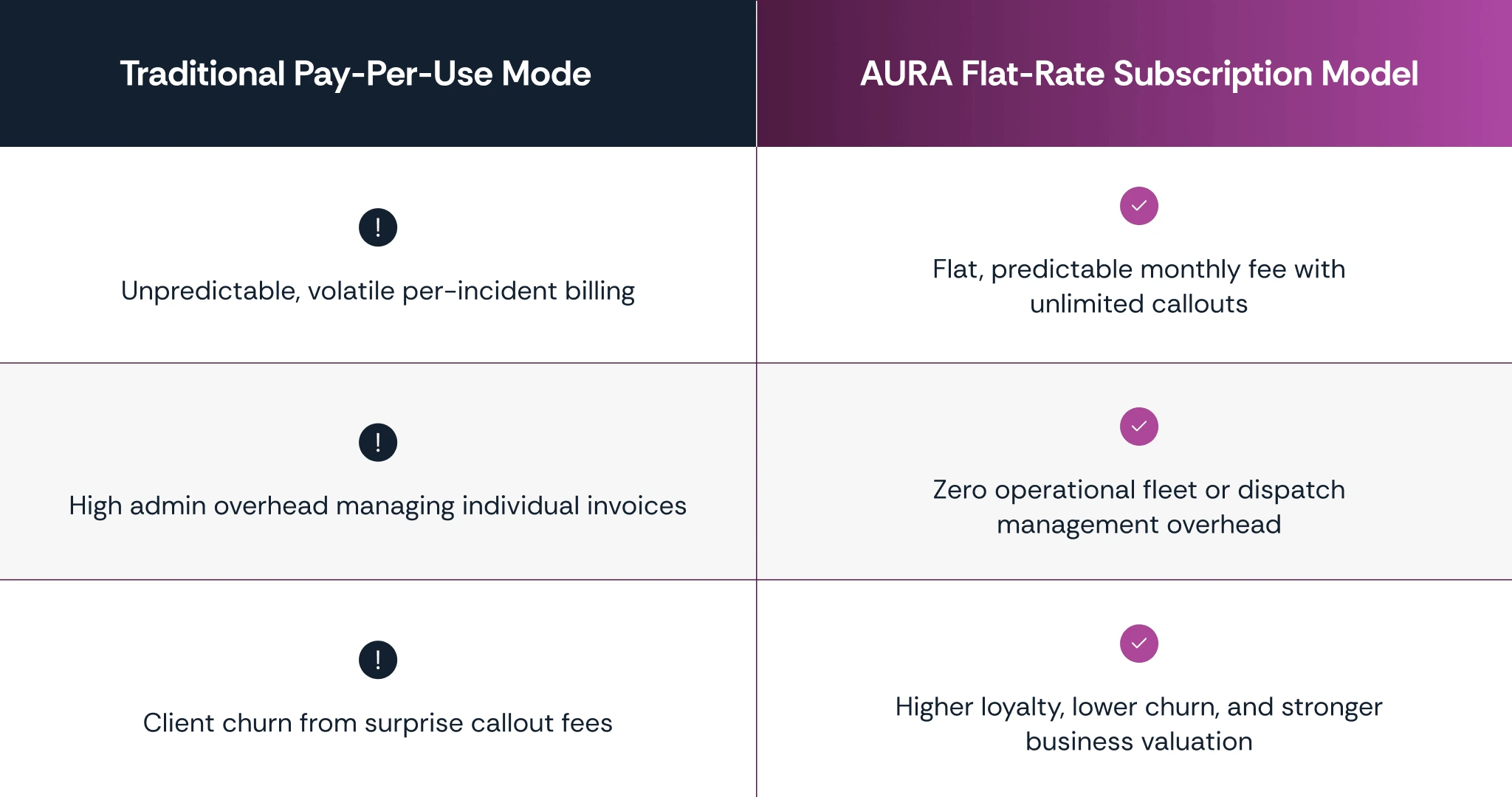
How is response billed? A flat subscription rate is preferable to mitigate unpredicatable costs to your clients..
Why UK installers are adding response now
Police response to intruder alarms in the UK is conditional. Systems need a Unique Reference Number issued by the local force and must meet National Police Chiefs' Council requirements.
According to the NSI, forces in England, Wales and Northern Ireland commit to immediate response subject to priorities. But that response is withdrawn after three false alarm calls in a rolling twelve-month period (NPCC policy).
When response is withdrawn, the alarm still sounds. What changes is who attends: the fallback is keyholder or private response
That is the commercial opening, and it is what an alarm installer programme is for. Your client's exposure isn't theoretical, it's written into national policy, and the answer becomes a capability you can sell rather than a caveat you have to explain.
In AURA's 2026 survey of more than 1,450 site owners, around 80% rated access to a trusted physical response service as highly appealing, indicating strong customer demand for a service that closes the gap between alarm activation and on-site attendance.
How response works alongside your alarm receiving centre
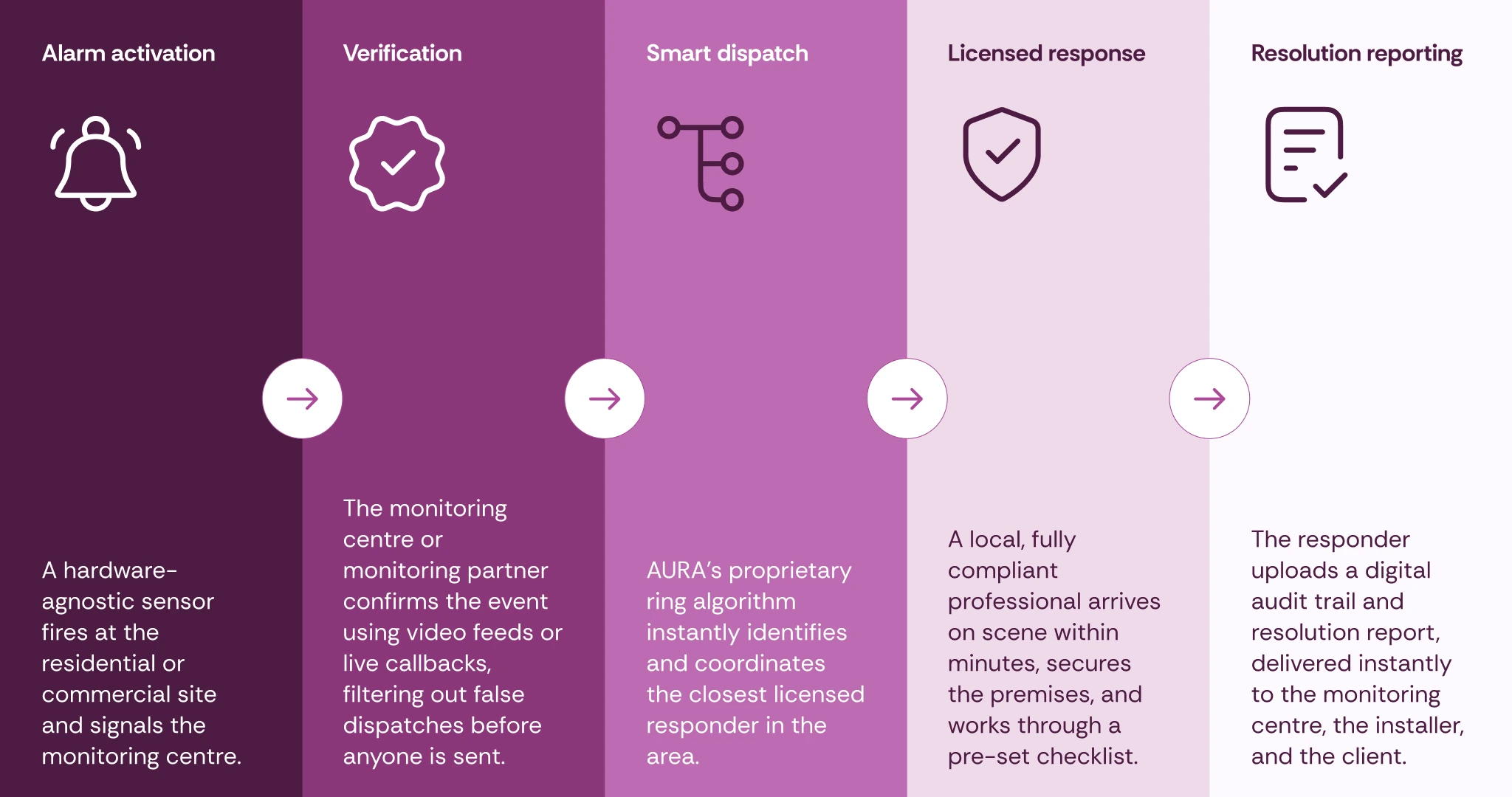
Response is a layer alongside your alarm receiving centre, not a replacement for it.
Alarm activation. A sensor fires at the residential or commercial site and signals the monitoring centre.
Verification. The monitoring centre confirms the event using video or a live callback, filtering out false dispatches before anyone is sent.
Smart dispatch. AURA's ring algorithm identifies and coordinates the closest licensed responder.
Licensed response. A local, fully compliant professional attends, secures the premises, and works a pre-set checklist.
Resolution reporting. The responder uploads an audit trail and resolution report, which reaches the monitoring centre, the installer, and the client instantly.
That audit trail is worth as much commercially as the attendance itself; it's what lets you prove performance at renewal rather than assert it.
What installers earn: wholesale, retail, and the margin between
A well-built alarm installer programme prices per site, not per callout. You buy each site at a wholesale rate and set the retail price yourself; the margin between the two is yours, it recurs monthly, and it doesn't erode the way hardware margin does.
The billing model matters as much as the rate. Per-incident callout fees generate the invoice arguments and cancellations that quietly erode a book, and any buyer valuing your business will price that attrition in. A flat monthly fee removes the surprise, which is why response tends to hold contracts rather than test them.
Performance is equally important because it’s part of the value you’re selling. At AURA, our average attendance time across the UK network is typically under 30 minutes, giving customers a reliable service they can count on.
Getting started: onboarding and field activation
Joining the alarm installer programme is a digital process, and it takes minutes rather than weeks.
Three-step onboarding
Complete a brief intake form.
Sign the partner agreement.
Receive full administrative access to the centralised client platform, then create logins for field, engineering, and sales staff.
Because AURA is already integrated with your ARC, there's no back-office delay between signing and selling.
Activating a site from the doorstep
A smartphone site-capture tool lets engineers configure and activate response for a client in the field, with no return visit. The process takes four steps:
Pin the site. Drop a location pin to set GPS boundaries and confirm the address.
Capture access. Enter entry codes, gate instructions, site risks, and key contacts.
Document the property. Upload photos and layout diagrams from the phone camera.
Connect and sync. Link the monitoring partner via a reference code to push the site live.
Competing with the national brands as an independent
The UK market is led by a handful of large national providers competing on scale and name recognition. An independent installer competes on relationship, responsiveness, and being the single point of contact for a client's security and response sharpens exactly that advantage.
Adding a trusted physical response capability gives you something the box-shifting competition often can't offer. It deepens the value of every contract and gives clients a concrete reason to stay rather than move to a national brand.
Because AURA's programme is hardware-agnostic and operates behind your brand, you can add national-scale response without giving up the independence your customers value.
You remain the trusted security partner. AURA provides the response infrastructure behind you.
Zane Van Rooyen
Product Marketing Manager
FAQs
Everything you need to know about AURA's Installer Programme
Does an alarm installer programme replace my existing alarm receiving centre?
No. AURA integrates alongside your monitoring centre to execute physical guard dispatch. Your existing monitoring relationship stays exactly as it is.
What happens if police response is withdrawn from my client's alarm?
The alarm still sounds, but attendance falls to keyholder or private response. An on-demand response layer means you already have a licensed responder available, rather than an escalation you can't service.
How do installers make money from the subscription model?
Installers pay a wholesale subscription rate per site and charge clients a retail price they set themselves. The margin between the two becomes recurring monthly revenue.
Do I keep my own branding and client relationships?
Yes. AURA runs as a behind-the-scenes response layer, so response reaches your client as part of your offering rather than a competing one.
Can engineers manage multiple client sites from one phone?
Yes. Engineers use unique mobile credentials to manage, update, and activate multiple sites on the move.
Ready to scale your recurring revenue?
If you want to lift project margins, cut false-alarm headaches, and offer physical response without running a fleet, the AURA alarm installer programme closes the loop for your business.
Join AURA at the Nevada Security Association in Las Vegas on October 28 for its annual Industry Get Together & Youth Scholarship Fundraiser.
United States
United States
•
November 18-19, 2026
LLSSA Convention
Meet AURA at the LLSSA 2026 Convention in Kenner and discover a new way to grow recurring monthly revenue from the accounts you already serve.
United States
United States
•
October 21-23, 2026
TBFAA Convention & Trade Show 2026
Meet AURA at the TBFAA Convention & Trade Show in College Station and explore how on-demand guard response can help you grow recurring monthly revenue from the accounts you already serve.






.webp)



.webp)






.svg)

.svg)
.svg)
.svg)
.svg)
.svg)
.svg)
.svg)
.svg)