The challenge of coordinating emergency response across every site
A national or global business may run as a single organisation, but each of its locations often relies on its own local safety arrangements.
Public emergency services cannot always respond quickly to a fire alarm, a medical emergency or an after-hours intrusion, so many organisations fill the gap with a different security partner, set of emergency contacts and site procedures at each location. Over time, incidents end up being handled differently from one site to the next, and the security team has no single place to see what happened.
An enterprise emergency response platform gives organisations one system for coordinating incidents across every property and region they operate in.
What is multi-jurisdictional emergency response coordination?
Multi-jurisdictional emergency response coordination gives an organisation that operates across several regions access to a network of security and medical responders through one platform.
Each response provider continues to cover its own area, while the organisation’s security team manages every incident in the same place, whichever provider attends. A business with offices, warehouses and distribution facilities in different regions can use one emergency response platform for all of them.
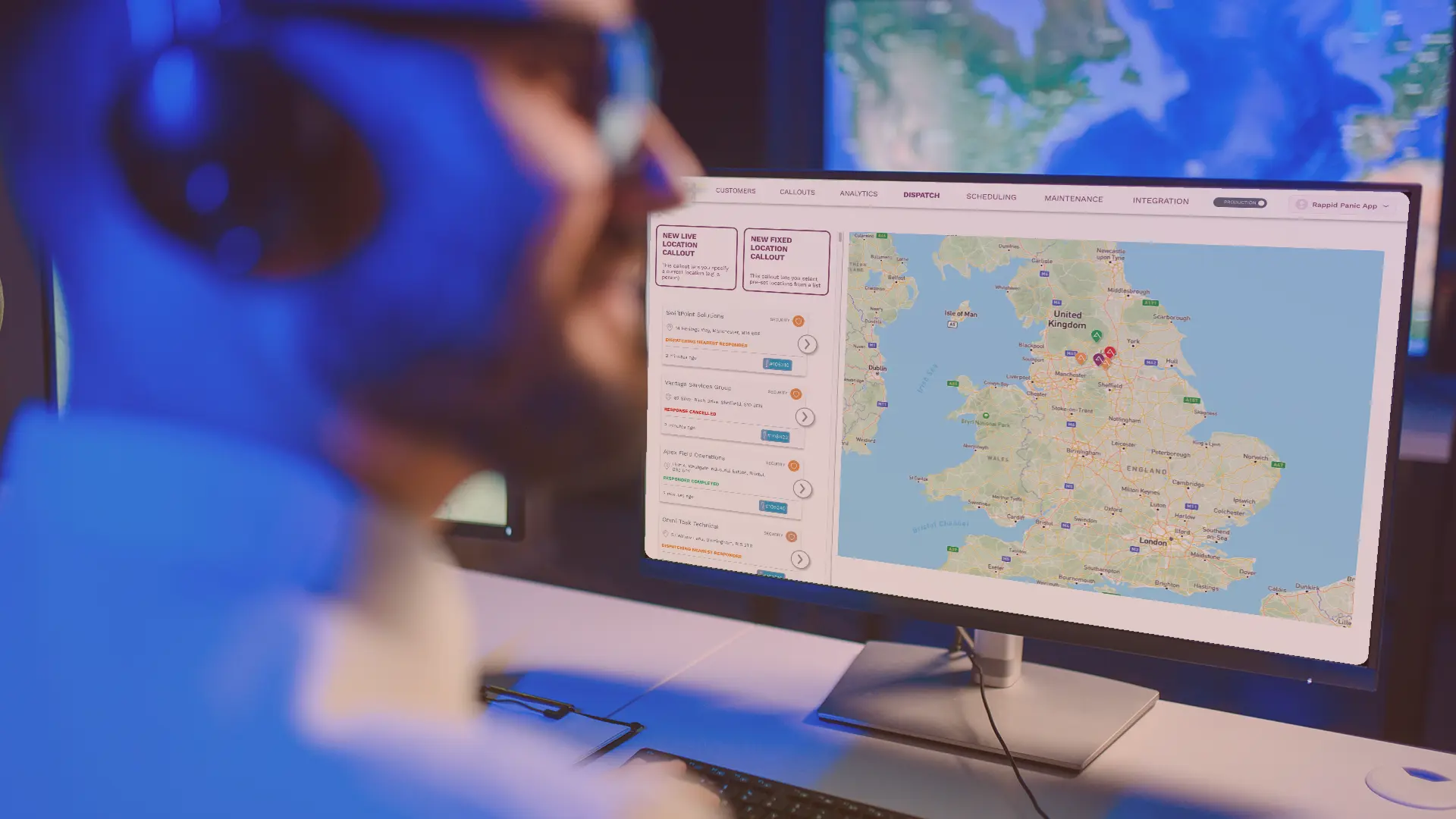
When an alert is raised, the nearest available local responder is dispatched and the organisation’s security team receives live updates. If a second incident happens at another site, it follows the same process with a different response partner, and both incidents appear in the same multi-region dispatch platform.
What enterprise platforms need vs. what monitoring centres provide
As an organisation grows across regions, emergency response stops being something each site manages for itself and becomes a responsibility of the central security team.
Security leaders need to know more than whether an alarm reached an operator. They need every location to follow the same response standards, every incident to appear in the same reports and every response partner to work from the same information. Those needs are where the role of an enterprise platform and the role of a monitoring centre separate.
A monitoring centre handles alarms. It receives signals, follows predefined procedures and contacts the people or services named in the customer’s instructions. That remains an essential part of many security programmes.
Enterprise security teams have a wider job. They oversee multiple facilities, security providers and internal stakeholders, and their obligations continue after a responder has been dispatched. They need to review response times, show that procedures were followed, spot patterns across sites and see what is happening across the whole estate rather than one property at a time. That depends on incident data being held in one place, not spread across individual alarm events at different providers.
Technology platforms have a similar problem. A platform that offers emergency response to its users cannot set up a new operational relationship every time it enters a new region. Each additional provider brings its own technical integration, procedures and reporting, and the product team has to maintain all of them for as long as the platform runs.
Enterprise customers also expect consistency. A security director does not want one reporting format in one region and a different one elsewhere, or different procedures at two facilities simply because they use different service providers. They want one system that covers every location, with local response companies continuing to do the work they know best.
Monitoring centres remain an important part of the security industry, but enterprise security covers more than alarm monitoring. That is why many organisations look for a monitoring centre alternative for enterprise that combines response coordination, incident reporting and integration across sites, rather than relying on alarm handling alone.
Comparing AURA, Global Response and Eaton ALERiTY
For enterprises evaluating global emergency response and critical incident tools, several established platforms are likely to come up during selection. The comparison below gives a high-level overview of AURA, Global Response and Eaton ALERiTY, covering what each offers, the technology behind it and whether it supports organisations operating in multiple countries.
| Capability |
AURA SOS |
Global Response |
Eaton ALERiTY |
| What it offers |
Emergency response platform |
Global security and crisis response services |
Mass notification platform |
| Primary focus |
Physical emergency response |
Crisis management and assistance |
Emergency communications |
| Core technology |
API-driven response platform |
24/7 Global Response Center |
Notification and alerting software |
| Integration |
REST APIs, webhooks, white label apps |
Enterprise workflow integration |
Fire, PA, telephony and IP system integration |
| Dispatch capability |
Dispatch to the nearest available vetted responder |
Human-coordinated dispatch |
No responder dispatch |
| Response network |
Private security, medical, roadside |
Security, medical, evacuation partners |
None |
| Control centre |
24/7 control room |
24/7 Global Response Center |
Notification management console |
| Coverage |
Response networks in multiple markets |
100+ countries |
Global enterprise deployments |
| Best suited for |
Embedded emergency response |
Global travel risk and crisis management |
Enterprise emergency notifications |
How AURA differs from a traditional monitoring centre
AURA does not operate as a traditional monitoring centre.
A traditional monitoring centre usually monitors alarm signals, assesses events and dispatches responders according to its own procedures and coverage area. Those responder relationships tend to be fixed, which leaves less flexibility when an incident falls outside the established service area or when another responder is much closer.
AURA identifies the nearest vetted responder based on location, availability and capability. That allows it to coordinate response across different regions without depending on a single responder network.
AURA also connects directly to enterprise systems through APIs. Workplace safety platforms, mobile applications, building management systems, IoT devices and other technologies can all send emergency events to AURA. People keep using the applications they already know, with emergency response coordination software working in the background, so nobody has to switch to a separate platform to request help.
When an organisation expands into a new region, its new locations connect to the same platform, so there is no need to set up emergency response from scratch each time. The security team keeps one view of incidents across the business, while local responders continue to provide assistance in their own areas.
Use cases for an enterprise emergency response platform
AURA’s enterprise emergency response platform supports organisations that need security response at sites, campuses or user locations in more than one region. Multi-site property portfolios.
A business with sites in several regions has to protect each one, whether it is occupied, vacant or closed after hours. Vacant properties attract trespassing, vandalism and theft, and alarm activations outside business hours need a security response. Where the risk is higher, some sites also benefit from static guarding or scheduled patrols.
With one enterprise emergency response platform, every property follows the same response process, wherever it is.
Enterprise campuses across regions
Large campuses have employees, contractors and visitors coming and going throughout the day. Security cameras and access control systems can flag suspicious activity and unauthorised entry, but they cannot intervene. A security responder can attend, assess the situation and act, which protects the people on site and keeps the campus running.
Technology platforms with embedded response
Many international technology platforms build safety features into their mobile applications, software or connected devices. Fintech platforms, last-mile delivery services, property alarm applications, visitor management systems and property management software can all give their users a way to request security response from inside the product.
One enterprise emergency response platform makes that possible across multiple regions through a single integration, without separate technical connections or provider management in each country.
Conclusion
For many enterprise buyers, emergency response is part of how they meet duty of care, protect their workforce and keep operations running across countries, rather than a standalone security service. The platforms that serve them best take alerts from the systems they already use and get a responder to the person who needs help, in each country where they operate.