Lone working policy: How scheduled security and escorting support your staff
A lone working policy is the set of procedures a business puts in place to protect employees who work without a colleague present, covering the moments when they're most exposed describing what support is available if something goes wrong. For predictable higher-risk moments, such as opening or closing alone, visiting isolated sites, leaving work late, or moving valuables, scheduled security and escorting can add a physical layer of protection alongside check-ins and emergency escalation.
A lone working policy can set out check-ins, communication and escalation procedures.
But the more practical question is what happens when someone actually needs physical support.
Sometimes that risk is predictable, such as opening or closing a site alone, visiting an isolated location or moving valuable equipment. In those situations, support can be scheduled in advance. In others, the risk develops unexpectedly and the policy needs a clear route to in-person response.
This article looks at how scheduled security, escorting and physical response can support a lone working policy across both planned and unplanned situations.
How can scheduled security support your lone working policy?
A lone working policy should answer a practical question: if an employee is working alone and something goes wrong, what have we put in place to protect them?
In many situations, regular contact, training and a clear escalation procedure may be appropriate. But not every lone-working risk can be managed through a phone call or app notification.
Some risks happen at predictable times. An employee opens a business before anyone else arrives. A manager locks up after dark. A member of staff arrives alone at an unfamiliar site. An employee needs to move stock or valuable equipment.
These are the moments where scheduled security services and security escorting can support a lone working policy: by putting physical security support in place for the specific period when the employee is most exposed.
Start with the lone working risk assessment
Scheduled security should not be the starting point, the lone working risk assessment should be. Employers need to understand what can realistically go wrong, who could be affected and what controls are appropriate, and the Management of Health and Safety at Work Regulations 1999 require it.
For lone workers, that could mean looking at:
What the employee is doing
Where they are working
Whether the location is isolated or unfamiliar
The time of day
Exposure to members of the public
Whether they are handling cash, stock or valuable equipment
How quickly someone would know if something went wrong
What support could realistically reach them
The important point is that not every part of someone's working day carries the same level of risk.
That creates an opportunity to identify specific windows where additional protection is appropriate, rather than treating every lone-working situation in exactly the same way.
Tom Sibley, Business Development Manager at AURA, works closely with businesses and security providers and has extensive experience across the security industry.
“It should sit on top of the risk assessment as a control for the risks already identified, not become a reason to stop doing the assessment properly.”
Where might scheduled security fit into a lone working policy?
Scheduled security works particularly well when the risk is both predictable and time-bound: instead of waiting for an incident to happen and then escalating, the business can arrange security support in advance for a particular activity, location or period.
Examples include:
Opening a business
Opening a site can create a predictable lone-working risk, particularly where the first employee would otherwise need to arrive early, unlock the premises, deactivate alarms or check that the site is secure before anyone else is present.
Where a risk assessment identifies this as a higher-risk activity, a business could schedule a security officer to carry out the opening procedure directly. This removes the need for an employee to manage that task alone and reduces their exposure before the working day begins.
Closing a business and late finishes
The same approach can apply at the end of the day. Rather than leaving the last employee on site to secure the premises alone, a scheduled security officer can attend at an agreed time to complete the lock-up procedure.
This can reduce the amount of time an employee spends alone on site and remove responsibility for higher-risk closing tasks from them altogether. Where an employee still needs to leave after dark or from an isolated location, escorting may provide an additional layer of support for the journey from the premises to an agreed safe point.
Visits to isolated or unfamiliar sites
Employees working across multiple locations may need to enter sites with few people around, or unfamiliar surroundings. The policy should set out what's appropriate here — for higher-risk visits, that could mean security meeting the employee on-site or accompanying part of the visit.
How can scheduled security support your lone working policy?
A lone working policy should answer a practical question: if an employee is working alone and something goes wrong, what have we put in place to protect them?
In many situations, regular contact, training and a clear escalation procedure may be appropriate. But not every lone-working risk can be managed through a phone call or app notification.
Some risks happen at predictable times. An employee opens a business before anyone else arrives. A manager locks up after dark. A member of staff arrives alone at an unfamiliar site. An employee needs to move stock or valuable equipment.
These are the moments where scheduled security services and security escorting can support a lone working policy: by putting physical security support in place for the specific period when the employee is most exposed.
Start with the lone working risk assessment
Scheduled security should not be the starting point, the lone working risk assessment should be. Employers need to understand what can realistically go wrong, who could be affected and what controls are appropriate, and the Management of Health and Safety at Work Regulations 1999 require it.
For lone workers, that could mean looking at:
What the employee is doing
Where they are working
Whether the location is isolated or unfamiliar
The time of day
Exposure to members of the public
Whether they are handling cash, stock or valuable equipment
How quickly someone would know if something went wrong
What support could realistically reach them
The important point is that not every part of someone's working day carries the same level of risk.
That creates an opportunity to identify specific windows where additional protection is appropriate, rather than treating every lone-working situation in exactly the same way.
Tom Sibley, Business Development Manager at AURA, works closely with businesses and security providers and has extensive experience across the security industry.
“It should sit on top of the risk assessment as a control for the risks already identified, not become a reason to stop doing the assessment properly.”
Where might scheduled security fit into a lone working policy?
Scheduled security works particularly well when the risk is both predictable and time-bound: instead of waiting for an incident to happen and then escalating, the business can arrange security support in advance for a particular activity, location or period. Examples include:
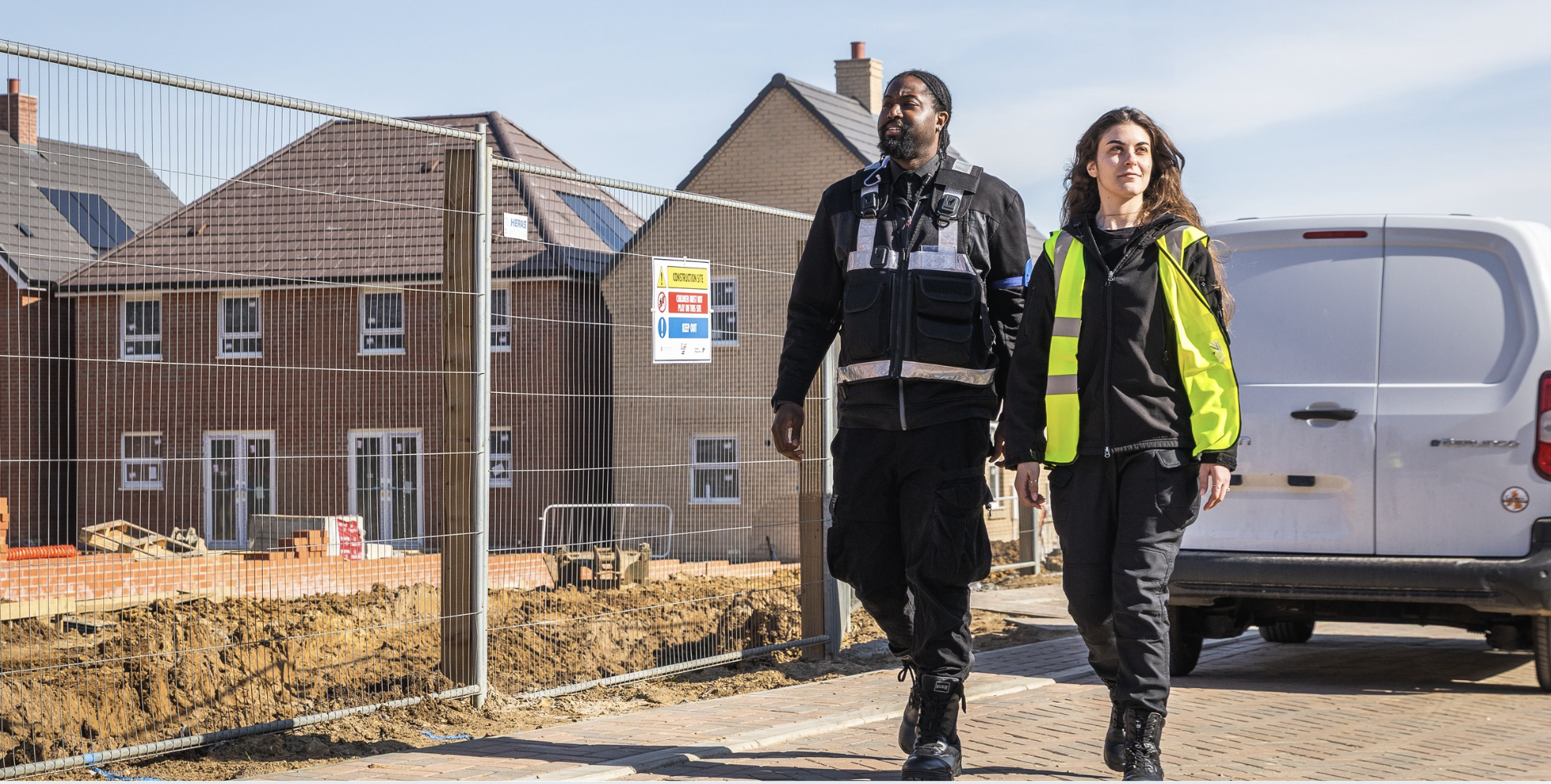
Alt text: Two AURA security escorts in hi-vis walking the perimeter of a UK construction site of new-build homes, illustrating scheduled security escorting for lone workers
Opening a business
Opening a site can create a predictable lone-working risk, particularly where the first employee would otherwise need to arrive early, unlock the premises, deactivate alarms or check that the site is secure before anyone else is present.
Where a risk assessment identifies this as a higher-risk activity, a business could schedule a security officer to carry out the opening procedure directly. This removes the need for an employee to manage that task alone and reduces their exposure before the working day begins.
Closing a business and late finishes
The same approach can apply at the end of the day. Rather than leaving the last employee on site to secure the premises alone, a scheduled security officer can attend at an agreed time to complete the lock-up procedure.
This can reduce the amount of time an employee spends alone on site and remove responsibility for higher-risk closing tasks from them altogether. Where an employee still needs to leave after dark or from an isolated location, escorting may provide an additional layer of support for the journey from the premises to an agreed safe point.
Visits to isolated or unfamiliar sites
Employees working across multiple locations may need to enter sites with few people around, or unfamiliar surroundings. The policy should set out what's appropriate here — for higher-risk visits, that could mean security meeting the employee on-site or accompanying part of the visit.
Alt text: Construction worker holding a hard hat and toolbox at a building site at sunset, representing a lone worker arriving at an unfamiliar or isolated site
When a lone worker needs physical support
Not every lone working risk can be planned around a set time.
A lone working policy may include several layers of protection, including risk assessment, training, communication, panic alerts and escalation procedures. The important question is what happens when one of those measures indicates that someone may need help in person.
That could follow a missed check-in, a panic activation from the employee or an alert raised by a third party. In each case, the business needs a clear escalation route that sets out what happens next, who takes responsibility and what support can realistically be sent.
Physical security response can form part of that process. Rather than replacing the other controls within a lone working policy, it provides an option when an incident reaches the point where someone is needed on the ground.
The same principle therefore applies in two different ways: where a higher-risk situation is known in advance, physical support can be scheduled around it; where something unexpected happens, the escalation procedure can define when an in-person response should be activated.
That physical support does not always need to be planned in advance. A lone worker may activate a panic alert, miss a scheduled check-in or find themselves in a situation where they no longer feel safe continuing alone. There may also be occasions where a manager would otherwise need to attend a site as a keyholder following an alarm, or where an employee needs an ad hoc chaperone visit because circumstances have changed unexpectedly. In these situations, the escalation procedure can include access to physical security response when it is needed, giving the business a practical alternative to asking an employee or colleague to manage the situation alone.
Physical security response complements your lone working policy
A strong lone working approach has several layers: risk assessment, training, communication and clear escalation procedures for when something goes wrong.
Physical security response adds another layer. In some situations, support can be arranged in advance around a known higher-risk activity. In others, it can be activated when an incident occurs and someone needs support on the ground.
Neither replaces the organisation's wider responsibilities to its lone workers. The purpose is to make sure the policy reflects what employees may actually experience and that there is a practical route to physical support when the risk requires it.
For businesses using AURA, that can include on-demand security response when an incident is escalated, keyholding response and chaperone support for unplanned situations, alongside scheduled security and escorting for planned requirements.
How to build scheduled security into a lone working policy
Treated as a control rather than an informal extra, the policy should make clear:
When it's required — the activities or circumstances that trigger it
Who can arrange it, and how much notice is needed
What it covers — meeting someone on-site, opening/closing, or escorting between points
What happens if plans change (a late finish, an overrunning visit)
How it escalates into the organisation's wider incident process
When it gets reviewed as hours, sites or risks change
From a policy on paper to protection when it matters
Having a lone working policy is important. The harder question is whether its controls reflect what employees actually experience. For each higher-risk activity, it's worth asking: when is this person most exposed, and what protection do they have during that specific window?
“For each serious risk identified, it's worth asking honestly: would anyone know in time, and could help actually get there fast enough to matter?” — Tom Sibley, AURA
If the answer is only that somebody will notice after they miss their next check-in, there's an opportunity to strengthen the control.
Scheduled security and escorting won't be necessary for every lone worker or every shift, but where a risk assessment identifies a predictable period of greater exposure, they give businesses a practical way to add support exactly where and when it's needed.
Yashvi Gupta
Marketing Executive
FAQs
Everything you need to know about scheduled services and escorting for lone workers
When should security escorting be considered for a lone worker?
That should be determined through the organisation's risk assessment. It may be appropriate where an employee faces a predictable period of elevated security risk, such as opening or closing a site alone, working at an isolated location, leaving after dark or carrying valuables.
Can security escorting replace lone worker check-ins?
No. They serve different purposes. Check-ins help employers maintain contact and identify when something may be wrong. Escorting provides a physical security presence during a defined period. Depending on the risks involved, an employer may use both as part of the same lone working policy.
What is the difference between scheduled security and emergency response?
Scheduled security is arranged in advance around a known activity, time or location. Emergency response is activated when an incident or alarm occurs. A lone working policy may use either or both, depending on the risks identified.
Add physical protection to your lone working plan
Give employees additional security support during the moments your lone working risk assessment identifies as higher risk.
Join AURA at the Nevada Security Association in Las Vegas on October 28 for its annual Industry Get Together & Youth Scholarship Fundraiser.
United States
United States
•
November 18-19, 2026
LLSSA Convention
Meet AURA at the LLSSA 2026 Convention in Kenner and discover a new way to grow recurring monthly revenue from the accounts you already serve.
United States
United States
•
October 21-23, 2026
TBFAA Convention & Trade Show 2026
Meet AURA at the TBFAA Convention & Trade Show in College Station and explore how on-demand guard response can help you grow recurring monthly revenue from the accounts you already serve.






.webp)


.webp)


.webp)





.svg)

.svg)
.svg)
.svg)
.svg)