Verified vs unverified alarms: what businesses need to know
Learn the difference between verified alarms and unverified alarms, why police may not attend, and how businesses can improve their security guarding response.
Many businesses assume that when an alarm goes off, police will respond immediately. In many U.S. cities, that is no longer guaranteed.
The reality is that most commercial properties still rely on unverified alarms — systems that trigger a signal without confirming whether there is a real threat — and as police departments manage higher call volumes with fewer resources, these alerts are often treated as low priority.
This blog explains the key differences between verified and unverified alarms, why law enforcement in many U.S. cities are now refusing to respond to unverified signals, and what this means for your business.
The main difference: verified vs unverified alarms
The type of alarm your business uses determines whether law enforcement treat an incoming signal as an emergency or ignore it altogether.
An unverified alarm gives monitoring centers no useful context. When a motion detector, door contact, or glass-break sensor is triggered, it sends a basic electronic signal. The monitoring agent knows a zone was breached — but has no way of knowing whether it was a burglar, a falling box, a stray animal, or a staff error.
Verified alarms work differently. They use multiple sources of evidence to actively confirm that a real threat is present. Instead of guessing, the monitoring center receives live proof at the time of the trigger.
Verification typically comes in three forms:
Video verification: Live or recorded footage that lets an operator see a human intruder on the property.
Audio verification: Live audio that captures sounds of a break-in, such as voices or tools being used to force a lock.
Human verification: Physical confirmation from an eyewitness or a professional on-site private responder.
The 98% false alarm problem and why law enforcement won't attend
To understand why this matters so much, it helps to look at the numbers.
In the United States, nearly 98% of security alarm activations are false. As highlighted by Origin Wireless, this “cry wolf” problem wastes enormous public resources. Responding to false alarms costs taxpayers and businesses around $1.8 billion every year in unnecessary dispatches, according to data from the AiN Group.
Because law enforcement is under so much pressure, many cities have had to change how they respond.
Law enforcement agencies are facing serious staffing shortages and rising call volumes. In response, major cities — including Seattle, Detroit, and Salt Lake City — have adopted “Verified Response” or non-response ordinances, as detailed by BOS Security.
Under these rules, law enforcement will not dispatch officers to an unverified alarm unless someone can confirm a crime is actually happening — through video, audio, eyewitness confirmation, or another approved method.
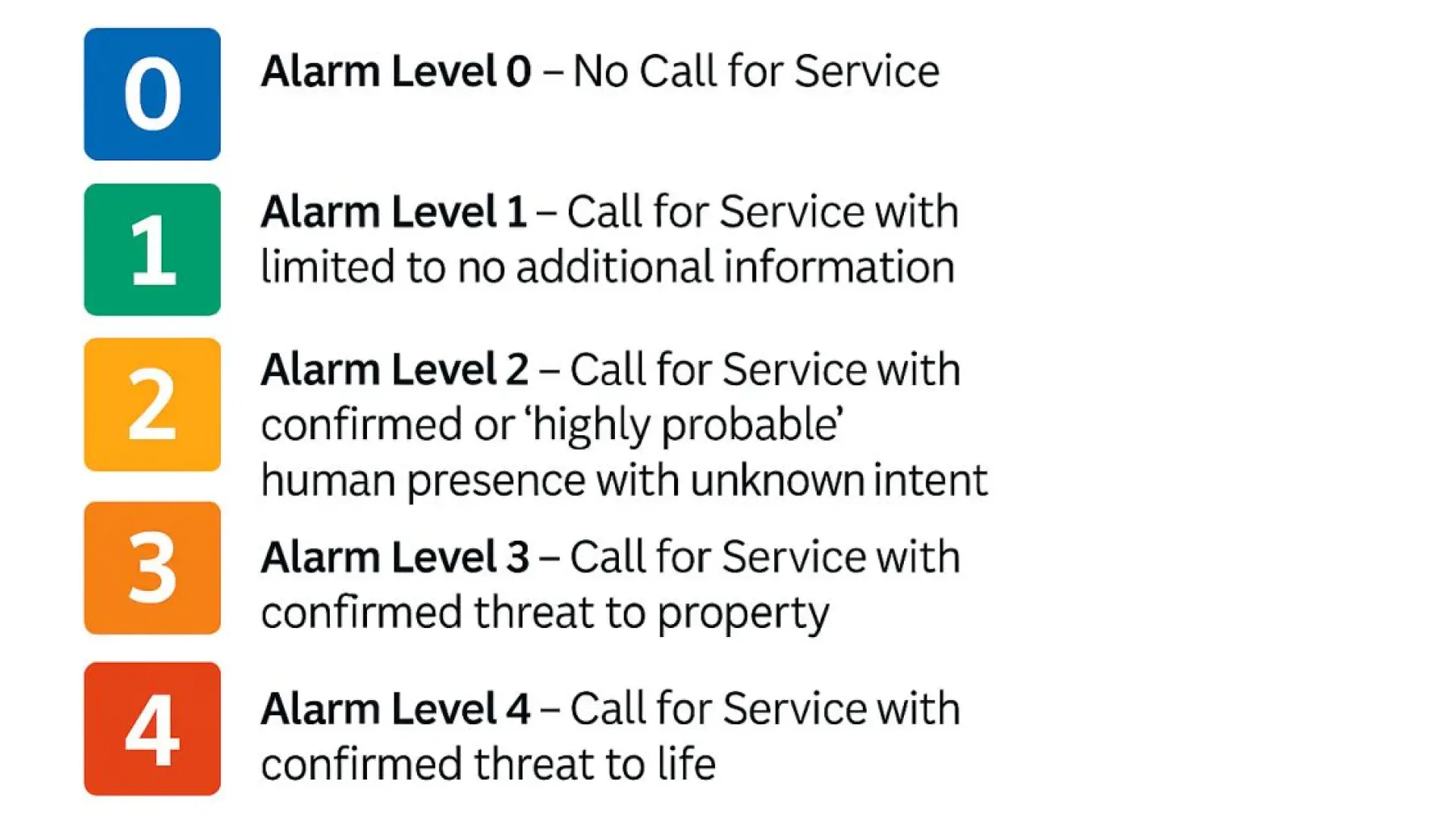
To standardize alarm priority across the country, the security industry created the ANSI/TMA AVS-01 Alarm Validation Scoring standard, published by The Monitoring Association. This system scores every alarm from Level 0 to Level 4:
Level 1 (Unverified): A basic sensor trigger with no proof of human presence. This gets the lowest dispatch priority and often results in law enforcement not attending at all.
Level 2-3 (Verified): A probable or visually confirmed threat to the property. This immediately upgrades the incident to a high-priority “crime in progress.”
Level 4 (Life Safety): A confirmed threat to human life, triggering an immediate emergency dispatch.
The dangerous security implications for your business
If your business still relies on basic door contacts and motion sensors, you may be facing more risk than you realize. Unverified alarms do not just mean slower response from law enforcement — they can leave your business completely unprotected during a real break-in.
The biggest risk is a long response delay. In many major cities, law enforcement can take 45 minutes or longer to arrive at a Level 1 (unverified) alarm. As Verkada points out, this gives experienced criminals more than enough time to steal high-value inventory, damage infrastructure, and access digital systems before any responder arrives.
There is also a serious financial risk. To manage the strain of false alarms on public resources, many local governments now issue heavy fines for repeated false dispatches. According to data tracked by Deep Sentinel, a faulty sensor or a staff error can result in hundreds of dollars in fines per incident. Your city may even suspend your alarm permit entirely if the problem continues.
Put simply, relying on an unverified alarm is no longer a safety net. It is a passive alert system that can fail you at the moment you need it most.
How modern security strategies solve the response gap
Modern commercial security needs a stronger, layered approach that combines verified alarms with private security response.
A good security strategy starts with faster alarm communication. Tools such as ASAP-to-PSAP, or Automated Secure Alarm Protocol, send verified alarm details directly to police dispatch systems in seconds.
However, even with faster communication, law enforcement may still not respond to an unverified alarm, or they may be delayed by higher-priority emergencies. That is why a strong security plan also includes private backup protection. Key options include:
Private mobile response: On-demand private patrol networks that can arrive quickly on-site to inspect the property, secure the perimeter, and guide emergency services if a breach is found.
Live incident tracking: Digital workflows that give facility managers real-time updates, including spatial data, timestamps, and live video links, throughout an active security emergency.
Remote AI guarding: Smart camera analytics that detect human presence before a sensor is triggered, allowing remote agents to issue live audio warnings and deter intruders before they can break in.
Turn alarms into action
Finding out that your current alarm system is unverified can feel unsettling. But it is also the first step toward making your business genuinely safer. As more police departments across the United States adopt non-response policies, relying on a traditional, unverified alarm is no longer a real security strategy — it is a liability.
The good news is that upgrading is possible. By switching to verified alarms and pairing them with private response networks, you take real control of your facility’s security.
At AURA, we help businesses close the dangerous gap left by stretched public resources. With AURA property protect, we ensure your property is backed by a fast, accountable, and guaranteed security response from the moment an incident is detected.
Yashvi Gupta
Marketing Executive
FAQs
Everything you need to know about verified vs unverified alarms.
What is the core difference between a verified and unverified alarm?
An unverified alarm is a blind sensor trigger sent without any proof of what caused it. A verified alarm uses live video, real-time audio, or physical eyewitness data to actively confirm to dispatchers that a human intruder is present on the property.
Why are U.S. police departments refusing to respond to unverified alarms?
Because nearly 98% of all traditional burglar alarm activations are false, police departments waste immense resources checking empty buildings. To protect their limited staff, many cities have implemented "Verified Response" rules where they will not dispatch officers unless the event is verified.
How does the AVS-01 standard affect my commercial security?
AVS-01 is a national standard that assigns a threat level score to your alarm signal. If your system cannot provide visual or audio proof of a threat, it receives a low Level 1 score, meaning dispatchers will place it at the very bottom of their priority list.
What are the security implications if my current alarm system is unverified?
If your system is unverified, you face massive response delays or complete non-attendance by law enforcement during a real break-in, exposing your business to severe theft and property damage. Additionally, you risk facing expensive false alarm fines from your local municipality.
What steps should I take if the police won't attend my business's unverified alarm?
You should instantly upgrade your infrastructure to support video or audio verification. Most importantly, you should incorporate private mobile response services to guarantee that a professional physical responder arrives on-site to protect your assets when public law enforcement is unavailable.
Protect your business beyond the alarm
AURA property protect adds a licensed security response layer to your alarm strategy, giving your business a guaranteed response when law enforcement can’t attend.
Join AURA at the Nevada Security Association in Las Vegas on October 28 for its annual Industry Get Together & Youth Scholarship Fundraiser.
United States
United States
•
November 18-19, 2026
LLSSA Convention
Meet AURA at the LLSSA 2026 Convention in Kenner and discover a new way to grow recurring monthly revenue from the accounts you already serve.
United States
United States
•
October 21-23, 2026
TBFAA Convention & Trade Show 2026
Meet AURA at the TBFAA Convention & Trade Show in College Station and explore how on-demand guard response can help you grow recurring monthly revenue from the accounts you already serve.





.webp)

.webp)
.webp)


.webp)





.svg)


.svg)
.svg)
.svg)
.svg)
.svg)