



This AURA site doesn’t match your location
Based on your location we think you may prefer SA website, where you’ll get regional content, offerings, and pricing

A practical guide for leaders evaluating which value-added services build trust, improve retention, and create defensible growth — without adding operational complexity.
Get the guideThe financial services industry is increasingly commoditised. With fees, speed, and coverage now largely the same across the industry, price-based competition has become a race to the bottom. To break this cycle, leadership teams are shifting focus to Value-Added Services (VAS).
Rather than treating these as "nice-to-have" extras, they are using them as strategic tools to build trust and retention without complicating regulated payment flows. The real challenge isn't deciding to add these services—it’s identifying which ones will actually drive growth.
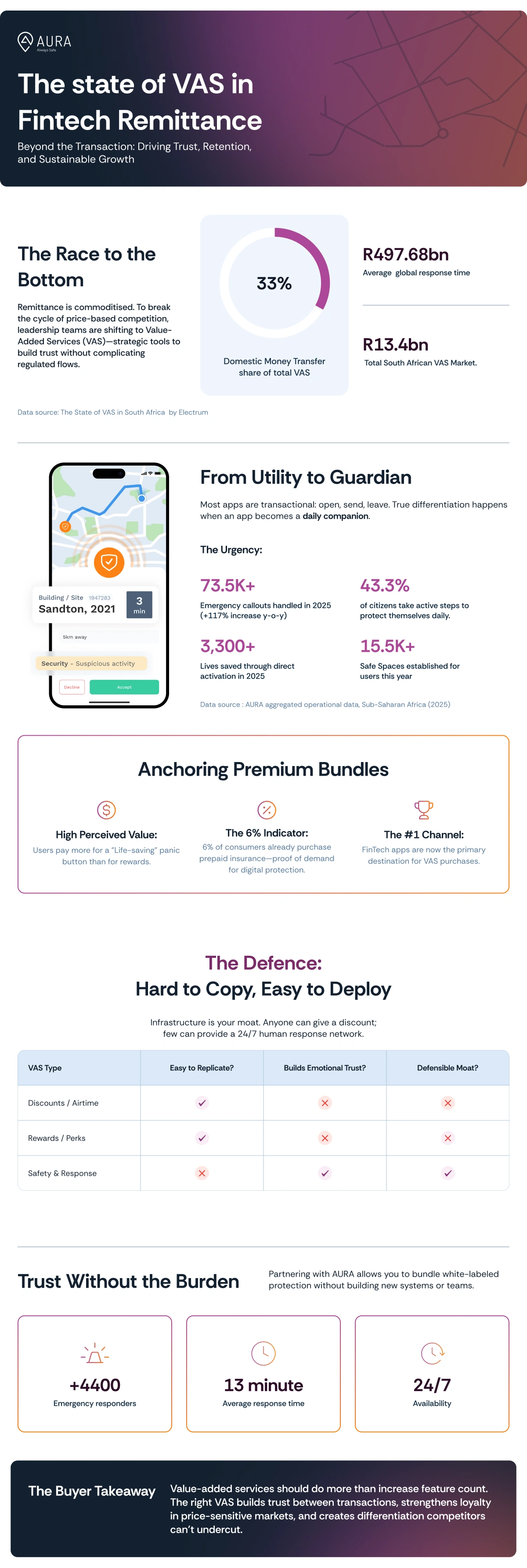
Most Fintech apps are transactional by design: open, send money, and leave. True differentiation happens when an app extends beyond the transfer and becomes a daily companion. VAS is the lowest-risk way to increase trust, improve retention, and grow Average Revenue Per User (ARPU).
When designed well, VAS sit alongside the core product, increasing perceived value and trust without adding friction to the user. In South Africa, the R497bn VAS market1 proves consumers are already primed to buy add-ons within financial apps.
1 The State of VAS in South Africa by Electrum
Total Value-Added Services market in South Africa
Domestic Money Transfer share of total VAS
International Money Transfer as an accepted VAS category

— Nived Maharaj, Head of Business Development at AURA
Most Fintechs default to generic rewards (airtime, discounts) that are easy for competitors to copy. Real differentiation comes from services customers feel: protection, safety and reassurance.
In South Africa, this need is urgent. 43.3% of citizens report taking active steps to protect themselves from crime daily2. With emergency activations triggered through AURA doubling year-on-year, personal safety is no longer a background concern—it is a daily, escalating crisis.
By combining financial tools with personal safety, Fintechs move from simple payment utilities to life-saving guardians. Just as a user can send money at the tap of a button, they can now summon help anytime, anywhere, through the same interface. This single mobile touchpoint captures both share of mind and share of wallet, transforming the smartphone into an essential tool for survival and lifelong trust.
2 Governance, Public Safety and Justice Survey (GPSJS) 2024/25
Emergency activations in 2025 (+117% increase y-o-y)
Lives saved through emergency activation
Safe spaces created
Instead of squeezing margins on transfer fees, protection-based services allow FinTechs to unlock new revenue streams. Because safety is perceived as a high-value necessity rather than a low-cost perk, it is the ideal anchor for premium tiering and subscription-based upgrades.
In South Africa, customers are willing to pay for protection. Six percent already purchase prepaid insurance 4, signalling clear demand for protection-adjacent services, particularly when offered inside trusted financial platforms.
4 The State of VAS in South Africa by Electrum

Users pay more for a "Life-saving" emergency button than for rewards.

6% of consumers already purchase prepaid insurance products– representing an appetite for protection.

FinTech apps are now the primary destination for VAS purchases.
Real safety and protection services require 24/7 human availability, real-time response capability, and operational readiness beyond traditional fintech infrastructure.
This complexity is precisely what makes protection-based VAS defensible. While any fintech can offer a discount code, providing a 24/7 human response network requires complex infrastructure. This complexity is your competitive moat.


— Justin Suttner, General Manager, AURA SSA
You don't need to build a security firm to offer safety. When delivered through a white-label partner like AURA, fintechs can bundle or upsell protection without building new teams, systems, or response infrastructure. This allows leadership teams to add trust, retention, and revenue — while keeping operational risk low and focus on core financial products.
Emergency responders in SSA
Average response time
Control centre availability
Value-added services should do more than increase feature count. The right VAS builds trust between transactions, strengthens loyalty in price-sensitive markets, and creates differentiation competitors can’t undercut.
Discover how protection-based VAS can help your organisation differentiate, strengthen loyalty, and unlock new revenue — while keeping operations simple.



.svg)


.svg)
.svg)
.svg)
.svg)
.svg)