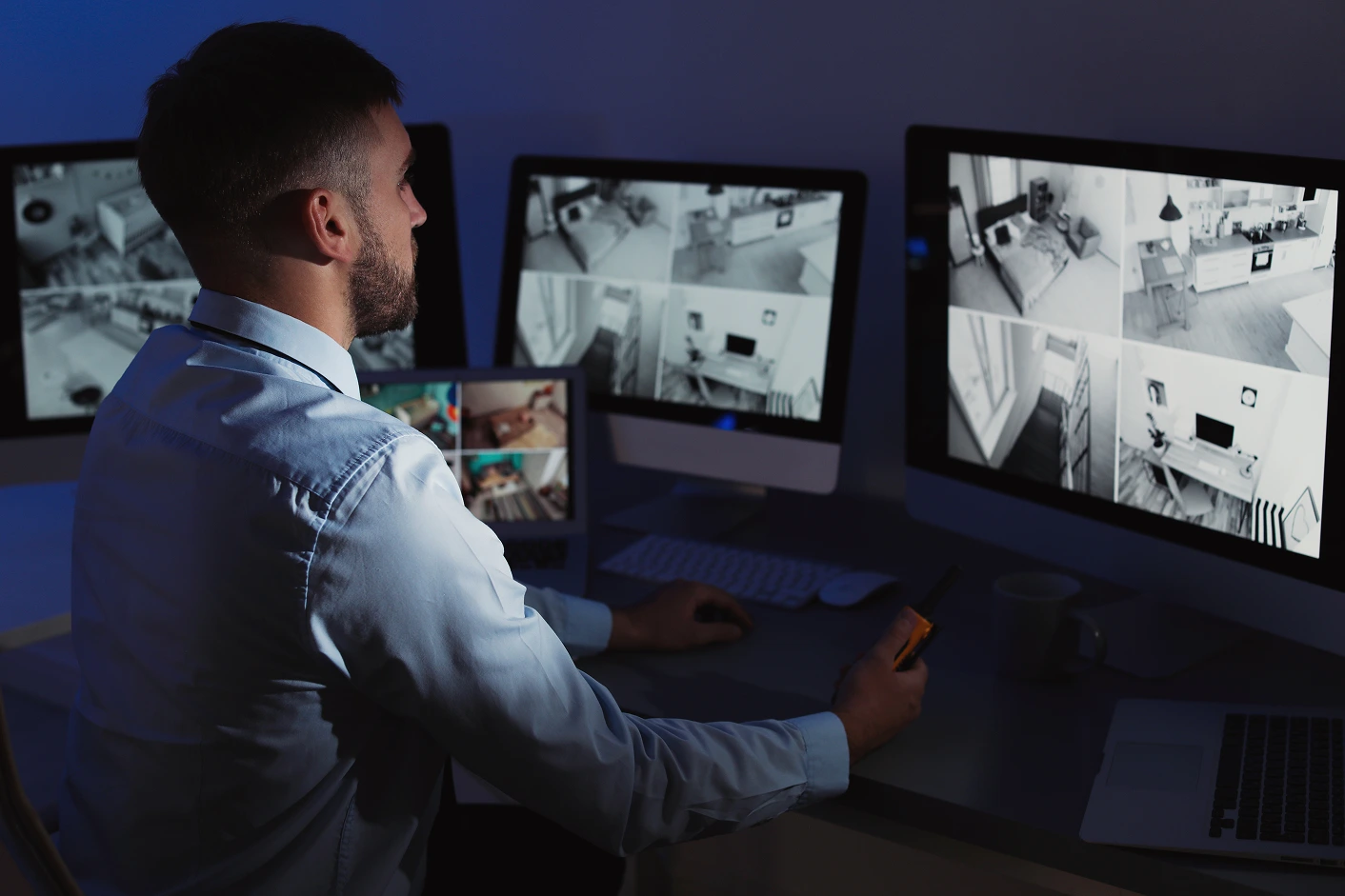
StopIt is a US-based video monitoring center that delivers live video monitoring services to commercial real estate portfolios, construction sites, auto dealerships, office environments, and other properties nationwide. StopIt’s monitoring model is designed around prevention. Operators actively monitor camera feeds, identify suspicious activity, and intervene before incidents escalate.
.webp)
.webp)


Live video monitoring has become a powerful tool for preventing crime across a wide range of properties - from parking garages and construction sites to offices, dealerships, and commercial facilities. Cameras allow operators to detect suspicious behaviour early and intervene before incidents escalate.
But the security landscape in the United States is changing. Law enforcement across major cities is facing resource constraints, and many jurisdictions now operate under verified-alarm response policies, under which police will only dispatch officers if a crime is confirmed.
This means that for many monitoring centers, simply detecting suspicious activity is no longer enough. Without a reliable on-site response, operators are often left watching incidents unfold on camera with limited ability to intervene.
By adding AURA’s dispatch platform to their monitoring workflow, StopIt gave their team the ability to dispatch a licensed security responder the moment suspicious activity is detected - bridging the gap between detection and real-world intervention.

Before adding AURA to their monitoring workflows, dispatching a security responder often required manual coordination and led to inconsistent response times.
This created several operational challenges:
- Cost barrier: To guarantee a response, StopIt explored building its own guard capability. But the economics simply didn’t work. Even a minimal deployment would cost thousands of dollars per month per guard.
- Delivering rapid security response in a changing environment: In many areas, law enforcement requires confirmation of a crime before dispatching officers.
- Reliance on police response: Police departments often lack the bandwidth to respond quickly to security incidents that are not immediately life-threatening.
- Operational frustration without response capability: Increased frustrations for operators who could detect incidents but couldn’t always intervene.
StopIt added AURA into its monitoring operations to provide a scalable and reliable response layer.
Through the AURA platform, operators can dispatch licensed security responders directly from their monitoring interface as soon as suspicious activity is confirmed.
With AURA, StopIt has access to:
- AURA’s aggregated responder network allows StopIt to provide response across multiple cities without managing separate guard providers.
- Immediate responder dispatch with live tracking ensures incidents are addressed quickly while keeping monitoring teams informed of responder progress.
- Real-time communication between responders and the monitoring center enables better situational awareness and faster decision-making.
- Digital reporting with photos and detailed incident notes provides clear documentation for accountability, auditing, and client reporting
This allows StopIt’s operators to escalate incidents quickly, while the platform handles responder coordination, tracking, and reporting.
Since adopting AURA into its monitoring operations, StopIt has strengthened both its operational performance and its customer value proposition.
- 18 minutes average guard response time to verified incidents: Automated dispatch reduces the time controllers spend managing security response.
- 25% of callouts resulted in the removal of suspicious individuals from monitored properties: Operators can dispatch a licensed responder within seconds of detecting suspicious activity.
- Full visibility into response activity with live responder tracking and digital incident reporting: Operators can confirm attendance, track responder activity, and receive digital evidence from the scene.
- Improved customer confidence: Clients receive detailed reports and images from the scene, providing greater transparency into what happened during incidents.
- Competitive advantage: Access to a nationwide security responder network enables StopIt to offer response capabilities typically available only to large security providers.
Want to build safety into your product?

Protection
Technology
Company
For Responders
For Businesses
Security & compliance